
What is a Dental Implant?
Implants are a tooth replacement option that involves placing a new "root" into the bone of your jaw. Once this titanium "root" has fused with your bone it can be used to support a crown, bridge, or denture. These implants can also be used to replace partials and other forms of dentures. The success rate for dental implants is extremely high and is due in part to the fact that root-form implants are made of a biocompatible material, titanium. Because titanium is accepted so well by the human body, it is also used for orthopedic implants, such as hip and knee replacements. Dental Implants have now become the standard for replacing older dentistry and missing teeth because they look and feel like your natural teeth and have a higher success rate than all other forms of tooth replacement. The initial cost is generally higher for an implant over other forms of tooth replacement, but the long-term benefits easily outweigh the difference in additional cost. An investment in implant dentistry is an investment in overall health, appearance, and well-being, as it involves preserving the integrity of facial structures, as well as replacing missing teeth.

Multiple Tooth Implants
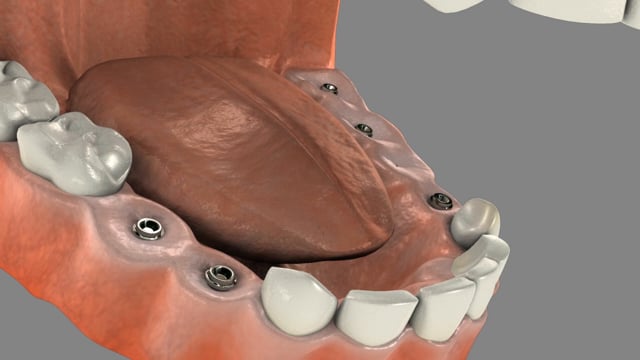
Multiple tooth implants may be placed if you need or desire to permanently replace an extracted or lost tooth. Titanium implant bases are placed into the jawbone to replace the job of the tooth roots. We allow a period of time to allow for the jawbone to heal over the bases before fitting for a crown. Next, abutments are screwed into the bases of the implants to allow crowns to be attached. Finally, custom fabricated crowns are placed over the abutments and will function like a real tooth.
Implant Placement
There are actually two phases to implant dentistry.
Phase 1: Using very accurate surgical techniques, an incision is made in the gum tissues and implants are placed into dimensionally controlled sites (depth and width) in the jawbone.
First, the gum tissue is opened and the jaw bone is tapped with a small drill and then drilled with a wider drill. The implant is inserted into place. The gum tissues are then closed and the healing phase begins. This may take anywhere from 3-6 months to ensure a strong base.
Phase 2: An abutment is secured to the top of the implant placing a new tooth crown onto the implant abutment. Implants can replace a single tooth, several teeth or your dentures.

Implant Benefits
- Eliminates the need to "cut down" the neighboring teeth to make a bridge.
- Maintains the jawbone structure.
- Feels and functions like natural teeth.
- Does not rely on other teeth for support.
- Replaces partial plates and may be used to secure loose dentures.
- Cleaned and flossed like a natural tooth.
